Codex Re-Analysis of the Interference Pattern from My 5-Bit ECC Key arXiv Paper
I wanted to use Codex to re-analyze the fixed 5-bit result from my IBM arXiv ECC key paper. The goal was to keep the backend data fixed, improve the readout of the interference structure, and see whether a better analysis pipeline could recover more information from the measured distribution itself. I set this up as an analysis-only workflow around the existing JSON result, with Codex restricted to improving the post-processing rather than touching any circuit code or changing the experiment.
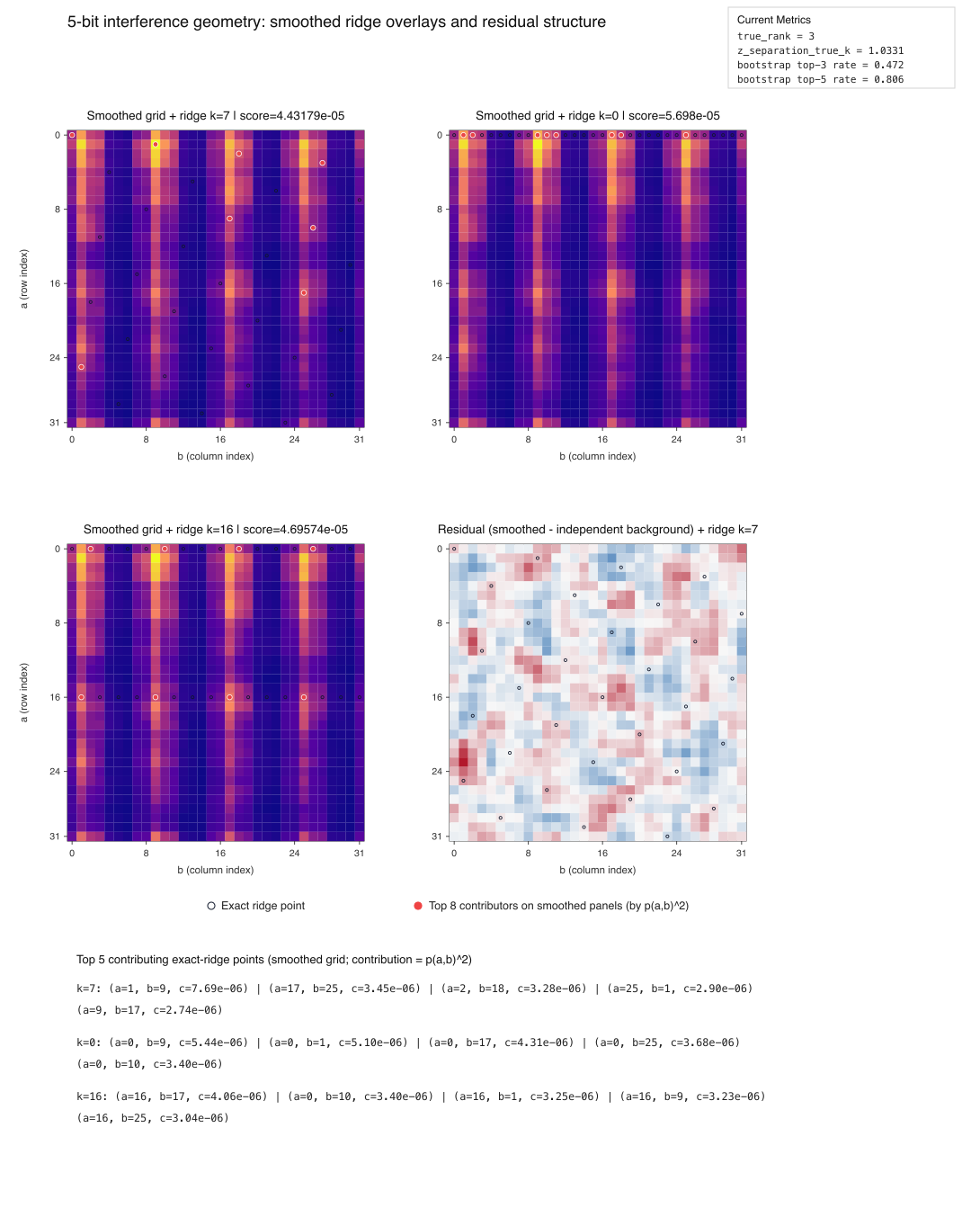
The first thing Codex uncovered was that the bitstring-to-(a,b) mapping mattered more than the initial score. Sweeping the plausible parsing conventions showed that the best baseline came from swapping the two 5-bit halves and not reversing either half. Just correcting that mapping moved the true key k = 7 from rank 26 in the global ridge-based slope ranking to rank 8, and changed the separation metric from negative to positive. After that, a light toroidal 3 x 3 smoothing step improved the true key to rank 3, and replacing the uniform exact-line sum with a weighted exact-line score using ∑p(a,b)^2 along the ridge increased the true-key separation further while keeping the ridge definition itself unchanged.
The final single-run result showed that k = 7 did not become rank 1, but it became a stable top-tier candidate. Under the final pipeline, the best key by score was still k = 0, while the true key remained rank 3 with a much stronger separation statistic than the raw baseline. To test whether that was just a one-off artifact, Codex added bootstrap resampling over the observed grid distribution. Across 500 bootstrap replicates, k = 7 was top 3 in 47.2% of runs and top 5 in 80.6% of runs, with a mean true rank of about 4.11 and a stable mean z-separation around 1.033. That suggests the k = 7 structure is a persistent feature of the measured distribution.
The next question was what was actually beating it. Codex added competitor diagnostics and showed that the false winners were not diffuse. The ranking was dominated by a recurring family led by k = 0 and k = 16. A geometric comparison then showed that these competitors do not substantially overlap the k = 7 ridge and are only weakly correlated with it. So their advantage does not seem to come from meaningful geometric equivalence to the true-key ridge.
In the end, the main thing I learned is that the fixed 5-bit result contains more recoverable structure than the original raw ridge score showed, but that structure lives inside a bias-dominated field with a small set of recurring competitors. The true key leaves a persistent and measurable interference signature, while the measured distribution also contains stronger modes driven by marginal structure and a few high-intensity cells. I’m open sourcing full analysis files, project, and note below.
Paper: arXiv:2507.10592 - Breaking a 5-Bit Elliptic Curve Key using a 133-Qubit Quantum Computer
Codex files
Analysis note (FIVE_BIT_INTERFERENCE_ANALYSIS_NOTE.md)
The first thing Codex uncovered was that the bitstring-to-(a,b) mapping mattered more than the initial score. Sweeping the plausible parsing conventions showed that the best baseline came from swapping the two 5-bit halves and not reversing either half. Just correcting that mapping moved the true key k = 7 from rank 26 in the global ridge-based slope ranking to rank 8, and changed the separation metric from negative to positive. After that, a light toroidal 3 x 3 smoothing step improved the true key to rank 3, and replacing the uniform exact-line sum with a weighted exact-line score using ∑p(a,b)^2 along the ridge increased the true-key separation further while keeping the ridge definition itself unchanged.
The final single-run result showed that k = 7 did not become rank 1, but it became a stable top-tier candidate. Under the final pipeline, the best key by score was still k = 0, while the true key remained rank 3 with a much stronger separation statistic than the raw baseline. To test whether that was just a one-off artifact, Codex added bootstrap resampling over the observed grid distribution. Across 500 bootstrap replicates, k = 7 was top 3 in 47.2% of runs and top 5 in 80.6% of runs, with a mean true rank of about 4.11 and a stable mean z-separation around 1.033. That suggests the k = 7 structure is a persistent feature of the measured distribution.
The next question was what was actually beating it. Codex added competitor diagnostics and showed that the false winners were not diffuse. The ranking was dominated by a recurring family led by k = 0 and k = 16. A geometric comparison then showed that these competitors do not substantially overlap the k = 7 ridge and are only weakly correlated with it. So their advantage does not seem to come from meaningful geometric equivalence to the true-key ridge.
In the end, the main thing I learned is that the fixed 5-bit result contains more recoverable structure than the original raw ridge score showed, but that structure lives inside a bias-dominated field with a small set of recurring competitors. The true key leaves a persistent and measurable interference signature, while the measured distribution also contains stronger modes driven by marginal structure and a few high-intensity cells. I’m open sourcing full analysis files, project, and note below.
Paper: arXiv:2507.10592 - Breaking a 5-Bit Elliptic Curve Key using a 133-Qubit Quantum Computer
Codex files
Analysis note (FIVE_BIT_INTERFERENCE_ANALYSIS_NOTE.md)