Codex Re-Analysis of the Interference Pattern from My IBM Quantum 6-Bit ECC Key Experiment
I wanted to use Codex to re-analyze the fixed 6-bit result from my IBM Quantum experiment in the same way I did my arXiv 5-bit paper's result. The goal was to keep the backend data fixed, improve the readout of the interference structure, and see whether a better analysis pipeline could recover more information from the measured distribution itself. I set this up as an analysis-only workflow around the existing JSON result, with Codex restricted to improving the post-processing rather than touching any circuit code or changing the experiment.
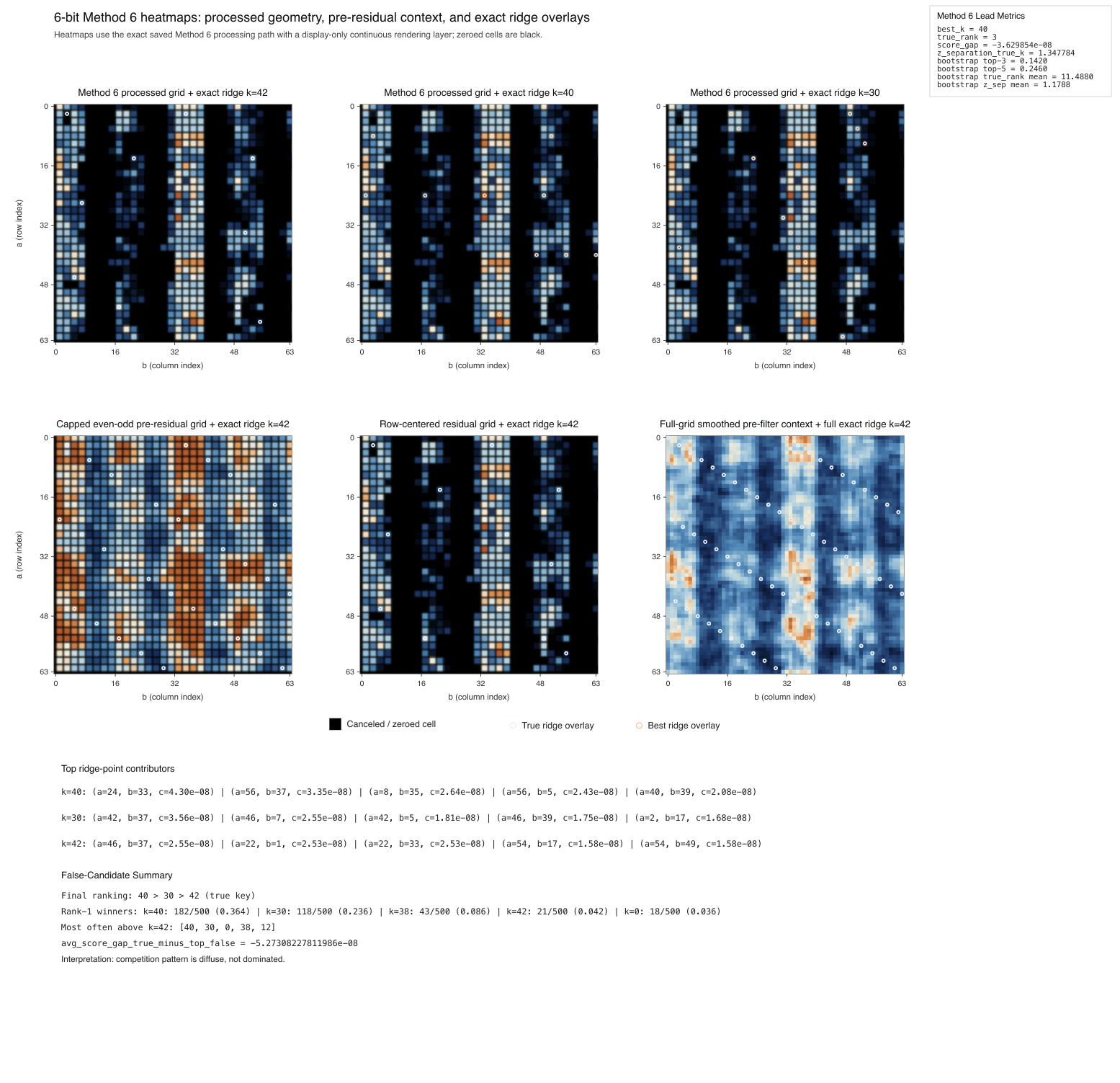
The first major jump came when Codex stopped treating the full grid as the only view and tested parity sectors directly. That identified the even-odd sector as the strongest sectoral view of the 6-bit result. From there, a sparse top-point capped-weight score improved the parity-sector result further, and the strongest overall result came from Method 6: a row-centered positive residual on top of the capped even-odd sector. In that mode, k = 42 improved to rank 3 in the single-run analysis, with a much stronger separation statistic than the full-grid baseline. Across 500 bootstrap replicates, the same pipeline gave a mean true rank of about 11.49, a top-3 rate of 14.2%, a top-5 rate of 24.6%, and a mean z-separation of about 1.1788. That suggests the k = 42 structure is a persistent feature of the measured distribution.
The next question was what was beating it. Early in the search, false competitors like k = 32 looked tied to simple symmetry structure in the 64-point modular grid, especially half-modulus effects and row-concentrated patterns. That is why later post-processing began to focus less on generic smoothing and more on targeted suppression of structured bias. Null-model normalization was informative because it did suppress the row-concentrated false competitor k = 32, but it also degraded the standing of k = 42, so it was not promoted. The better result came from a milder strategy: preserve the even-odd sector, keep the capped weighted ridge score, then subtract row-centered bias only enough to suppress the dominant structured pattern without destroying the true-key signal. That is what pushed the 6-bit result from a weak ridge into a competitive one.
The final top three candidate states in Method 6 were k = 40, k = 30, and k = 42, so the true key rose to rank 3 with only two false candidates still above it. A geometric comparison then showed that those two competitors do not substantially overlap the k = 42 ridge. Their exact ridge overlap with k = 42 is low, their active-support overlap on the final processed grid is zero, their ridge-intensity correlation with the true ridge is near zero and slightly negative, and neither shares any of the true ridge’s top contributing points. That suggests k = 40 and k = 30 are not nearby deformations of the true-key ridge, but different structured modes that still survive in the same interference field.
In the end, the main thing I learned is that the fixed 6-bit result contains more recoverable structure than the original raw ridge score showed, but extracting it required a more selective lens than the 5-bit case. The current best-supported 6-bit post-analysis result is Method 6: the even-odd parity sector with toroidal 3 x 3 smoothing, capped-weight weighted exact-line ridge scoring, and a row-centered positive residual. In that mode, the true key leaves a much stronger and more persistent interference signature than the raw baseline suggested. I’m open sourcing the full analysis files, project, and note below.
6-bit ECC Key Experiment
Codex files
Analysis note (SIX_BIT_INTERFERENCE_ANALYSIS_NOTE.md)
Paper: arXiv:2507.10592 - Breaking a 5-Bit Elliptic Curve Key using a 133-Qubit Quantum Computer
Codex Re-Analysis of the Interference Pattern from My 5-Bit ECC Key arXiv Paper
The first major jump came when Codex stopped treating the full grid as the only view and tested parity sectors directly. That identified the even-odd sector as the strongest sectoral view of the 6-bit result. From there, a sparse top-point capped-weight score improved the parity-sector result further, and the strongest overall result came from Method 6: a row-centered positive residual on top of the capped even-odd sector. In that mode, k = 42 improved to rank 3 in the single-run analysis, with a much stronger separation statistic than the full-grid baseline. Across 500 bootstrap replicates, the same pipeline gave a mean true rank of about 11.49, a top-3 rate of 14.2%, a top-5 rate of 24.6%, and a mean z-separation of about 1.1788. That suggests the k = 42 structure is a persistent feature of the measured distribution.
The next question was what was beating it. Early in the search, false competitors like k = 32 looked tied to simple symmetry structure in the 64-point modular grid, especially half-modulus effects and row-concentrated patterns. That is why later post-processing began to focus less on generic smoothing and more on targeted suppression of structured bias. Null-model normalization was informative because it did suppress the row-concentrated false competitor k = 32, but it also degraded the standing of k = 42, so it was not promoted. The better result came from a milder strategy: preserve the even-odd sector, keep the capped weighted ridge score, then subtract row-centered bias only enough to suppress the dominant structured pattern without destroying the true-key signal. That is what pushed the 6-bit result from a weak ridge into a competitive one.
The final top three candidate states in Method 6 were k = 40, k = 30, and k = 42, so the true key rose to rank 3 with only two false candidates still above it. A geometric comparison then showed that those two competitors do not substantially overlap the k = 42 ridge. Their exact ridge overlap with k = 42 is low, their active-support overlap on the final processed grid is zero, their ridge-intensity correlation with the true ridge is near zero and slightly negative, and neither shares any of the true ridge’s top contributing points. That suggests k = 40 and k = 30 are not nearby deformations of the true-key ridge, but different structured modes that still survive in the same interference field.
In the end, the main thing I learned is that the fixed 6-bit result contains more recoverable structure than the original raw ridge score showed, but extracting it required a more selective lens than the 5-bit case. The current best-supported 6-bit post-analysis result is Method 6: the even-odd parity sector with toroidal 3 x 3 smoothing, capped-weight weighted exact-line ridge scoring, and a row-centered positive residual. In that mode, the true key leaves a much stronger and more persistent interference signature than the raw baseline suggested. I’m open sourcing the full analysis files, project, and note below.
6-bit ECC Key Experiment
Codex files
Analysis note (SIX_BIT_INTERFERENCE_ANALYSIS_NOTE.md)
Paper: arXiv:2507.10592 - Breaking a 5-Bit Elliptic Curve Key using a 133-Qubit Quantum Computer
Codex Re-Analysis of the Interference Pattern from My 5-Bit ECC Key arXiv Paper